
Think Ahead with Life Imaging:
A quick, noninvasive brain CT scan creates detailed images of the brain and surrounding structures, providing information that may deserve further medical attention.
Available to qualifying households once every five years. Coronary calcium imaging can identify calcified plaque that may be present before symptoms appear.
Request your brain scan below
You have taken an important first step towards optimizing your health with Life Imaging!
A scheduling agent will call you shortly from our office at (954) 834-6362 to confirm your appointment. To streamline this process and reserve your scan, please answer this potentially life-saving phone call.
If you have any urgent questions, we're available Monday through Saturday, 8:00 AM to 4:00 PM.

Brain CT
A MORE INFORMED VIEW OF BRAIN HEALTH
The brain is protected by the skull, which means many changes cannot be evaluated through a physical examination alone. CT imaging provides a closer look at the brain, skull, fluid-filled spaces, and other structures within the head.
Life Imaging provides preventive brain CT scans at convenient locations across Florida. A licensed radiologist reviews your images and prepares a written report for you to discuss with your healthcare provider.
A brain scan is not appropriate for every person or every neurological concern. Your healthcare provider can help determine whether CT, MRI, or another form of evaluation is best suited to your needs.
BRAIN HEALTH IN PERSPECTIVE
Brain health can be affected by age, blood pressure, vascular health, previous injuries, family history, and numerous medical conditions. Imaging findings should always be considered alongside your symptoms, medical history, and clinical evaluation.
The Centers for Disease Control and Prevention reports that more than 795,000 people in the United States experience a stroke each year.
According to the CDC, stroke is a leading cause of death and a major cause of serious disability among American adults.
The National Cancer Institute explains that brain tumors may be benign or malignant. Their effects depend on their type, size, location, and how they affect nearby brain tissue.
WHAT LIFE IMAGING OFFERS
A Life Imaging brain scan uses CT technology to create cross-sectional images of the brain, skull, and surrounding structures. The examination may reveal visible changes that require closer evaluation or provide additional information for a conversation with your healthcare provider.

Life Imaging will confirm whether contrast is used for your particular scan. Most preventive brain CT examinations are performed without sedation, and patients can usually resume their normal activities immediately afterward.
The imaging portion usually takes only a few minutes. Nothing is inserted into the body during a standard noncontrast scan.
Most adults do not require sedation and can leave the imaging center after completing the appointment.
Preparation is generally limited. The team will explain whether you need to follow any specific instructions before arriving.
CT imaging creates multiple views of the head, allowing the radiologist to examine structures that cannot be assessed through an external examination.
A licensed radiologist examines the completed images and records the relevant observations in a written report.
Your healthcare provider can review the report alongside your symptoms, medications, health history, and results from any previous neurological evaluations.
INFORMATION FOR YOUR NEXT HEALTH CONVERSATION
A neurological examination evaluates movement, balance, reflexes, speech, memory, sensation, and other functions. A brain CT scan adds visual information by showing physical structures within the head.
The scan may help you and your healthcare provider:
CT images provide views of the brain, skull, ventricles, and other structures included within the scanned area.
The scan may show calcifications, changes in the size of the ventricles, evidence of some previous injuries, certain masses, or other structural findings.
When clinically appropriate, an initial scan may provide images that can be compared with future examinations if a healthcare provider recommends additional monitoring.
A finding may help your provider decide whether no further action is needed or whether another examination, such as MRI, vascular imaging, or specialist evaluation, would be more informative.
Your report gives you and your healthcare provider specific imaging observations to discuss instead of relying on symptoms or concerns alone.
A preventive brain CT scan does not make a diagnosis or treatment decision by itself. Its purpose is to provide images that a qualified healthcare professional can interpret within the context of your overall health.
WHO MAY CONSIDER A BRAIN SCAN
People consider brain imaging for different reasons. Some want to discuss a past injury or medical history, while others have been advised by a healthcare provider to obtain more information.
A history of neurological disease, previous head injury, cancer, vascular disease, or another medical condition may lead to a conversation about appropriate imaging.
Your healthcare provider may want to compare current images with an earlier CT or MRI to determine whether a known finding has remained stable.
A clinician may recommend CT imaging when it is suited to the question being investigated or when another form of imaging is not appropriate.
If an earlier test identified calcification, ventricular enlargement, an old injury, or another structural observation, a provider may discuss whether follow-up imaging is useful.
You may be comparing CT with MRI or another neurological test. The Life Imaging team can explain the appointment, but your healthcare provider should determine which test fits your medical needs.
A preventive brain scan is intended for nonemergency situations. New or worsening neurological symptoms require prompt medical evaluation rather than a routine screening appointment.
WHAT THE BRAIN SCAN EVALUATES
A brain CT scan produces detailed images of the structures within the head. What can be seen depends on the scan protocol, whether contrast is used, image quality, and the nature of any finding.
Your report may describe:
MedlinePlus, a service of the National Library of Medicine, explains that a head CT creates detailed pictures of the head, including the skull, brain, eye sockets, and sinuses.
A finding on the report is not automatically a diagnosis. Some observations are harmless variations, while others require comparison imaging or further evaluation. Your healthcare provider can explain what the language in your report means for you.
A CLEAR UNDERSTANDING OF THE SERVICE
Understanding the limits of CT imaging is an important part of making an informed decision.
A preventive brain CT scan does not:
A normal CT result does not guarantee that every aspect of your brain health is normal. Some conditions may be too small, too early, or better visualized with MRI or another test.
If you experience sudden facial drooping, weakness or numbness on one side, difficulty speaking, confusion, loss of balance, a sudden severe headache, a seizure, or loss of consciousness, call 911 immediately. The CDC emphasizes that suspected stroke symptoms require emergency care.
YOUR BRAIN SCAN APPOINTMENT
Complete the appointment request and select your preferred Life Imaging location. A team member will contact you to discuss availability and the details of the scan.
Preparation is usually minimal. Tell the scheduling team about pregnancy, previous brain imaging, implanted medical devices, recent procedures, and any relevant medical conditions.
Bring a list of your medications and copies of previous imaging reports if they are available.
You will lie on a padded CT table while the technologist positions your head. Supports may be used to help you remain comfortable and still.
The table moves through a wide, ring-shaped scanner while the images are taken. The scan is painless, and sedation is generally unnecessary.
A licensed radiologist examines the images and prepares a written report describing the relevant findings.
Life Imaging provides your results so you can review them with your primary care provider, neurologist, or another qualified healthcare professional.
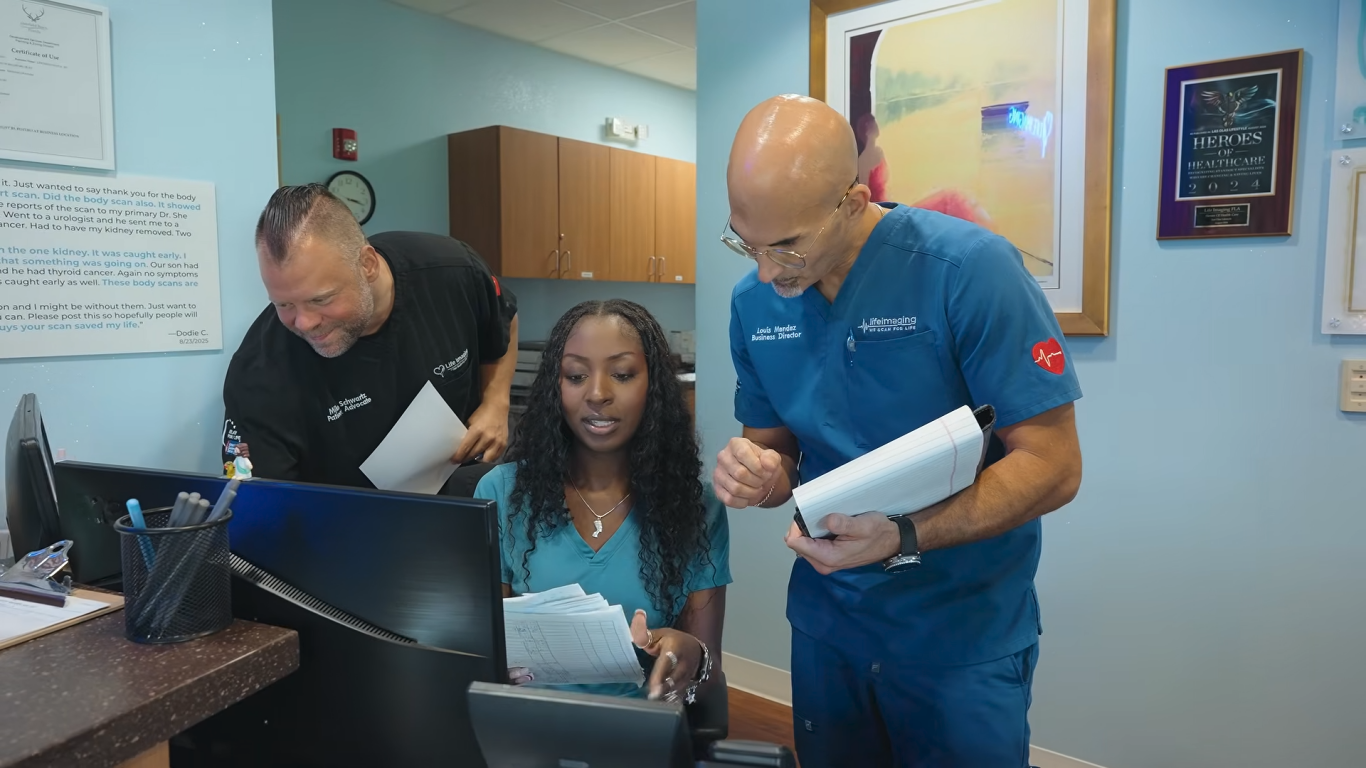
PATIENT-FOCUSED PREVENTIVE IMAGING
Life Imaging makes the screening process easier to understand from your initial request through the delivery of your report.
Efficient Outpatient Imaging
Brain CT scans are completed in an outpatient setting without a hospital stay or recovery period.
Low-Dose CT Technology
Life Imaging uses CT protocols designed to obtain useful images while limiting radiation exposure when appropriate. Radiation dose varies by examination and individual factors.
The U.S. Food and Drug Administration recommends weighing the expected benefit of CT imaging against its radiation exposure.
Licensed Radiologist Review
A licensed radiologist interprets the scan and prepares a written report for you and your healthcare provider.
Clear Appointment Guidance
The Life Imaging team explains the preparation, scan process, location, and expected timeline for receiving your results.
Convenient Florida Centers
Multiple Florida locations allow patients to select a Life Imaging center that is convenient for their schedule and community.
Learn more about Life Imaging and read Life Imaging patient stories.
BRAIN SCAN LOCATIONS
Life Imaging offers preventive imaging services at centers across Florida:
Jacksonville is coming soon to serve patients throughout Northeast Florida.
Availability of brain CT screening may vary by location. The scheduling team will confirm where the service is currently offered.
MORE PREVENTIVE SCREENING OPTIONS
Brain imaging may be one part of a broader conversation about preventive health. Life Imaging also provides focused CT screening for other areas of the body.
A low-dose CT heart scan looks for calcified plaque in the coronary arteries and provides a coronary calcium score.
Low-dose CT lung screening creates detailed images of the lungs for eligible adults with relevant risk factors.
CT-based cancer screening examines selected areas for visible findings that may require further medical evaluation.
Virtual colonography creates detailed views of the colon and rectum without sedation or a traditional colonoscope.
This examination provides detailed CT images of selected organs and structures within the abdomen and pelvis.
Each service has a different purpose, preparation process, and set of limitations. Your health history and provider’s guidance can help determine which type of imaging is appropriate.
FREQUENTLY ASKED QUESTIONS
The scan creates detailed images of the brain, skull, ventricles, and nearby structures. It may show certain calcifications, structural changes, evidence of some previous injuries, certain masses, or another visible finding. The scan cannot detect every neurological condition.
No. The scan does not hurt. You will need to lie still while the table moves through the scanner, but the machine does not touch your head while taking the images.
The use of contrast depends on the examination protocol and the medical question being considered. The scheduling team will confirm whether contrast is part of your scan and explain any related preparation.
The imaging portion usually takes only a few minutes. Your complete visit will take longer because of registration, preparation, positioning, and instructions.
No. A CT scan cannot diagnose Alzheimer’s disease by itself. Evaluating memory or cognitive changes may involve a medical history, cognitive testing, laboratory work, neurological assessment, and other imaging when appropriate.
A licensed radiologist interprets the images and prepares a written report. Review the report with your primary care provider, neurologist, or another qualified healthcare professional who can explain the findings in the context of your health.
A CLOSER LOOK STARTS WITH A CONVERSATION
A brain CT scan may provide useful structural information, establish images for future comparison, or identify a finding that deserves a closer medical look. It is one part of understanding brain health, not a substitute for a complete neurological evaluation.
Request your appointment and select the Life Imaging center that is most convenient for you. Our team will confirm service availability, explain the preparation requirements, and help you plan your visit.
Preventive brain imaging does not replace routine medical care, neurological assessment, diagnostic testing, or emergency evaluation. Screening suitability varies by individual. Review your results with a qualified healthcare provider.